Interpreting a room air quality sensor
A reading describes what the device senses, not automatically the overall quality or safety of the room's air.
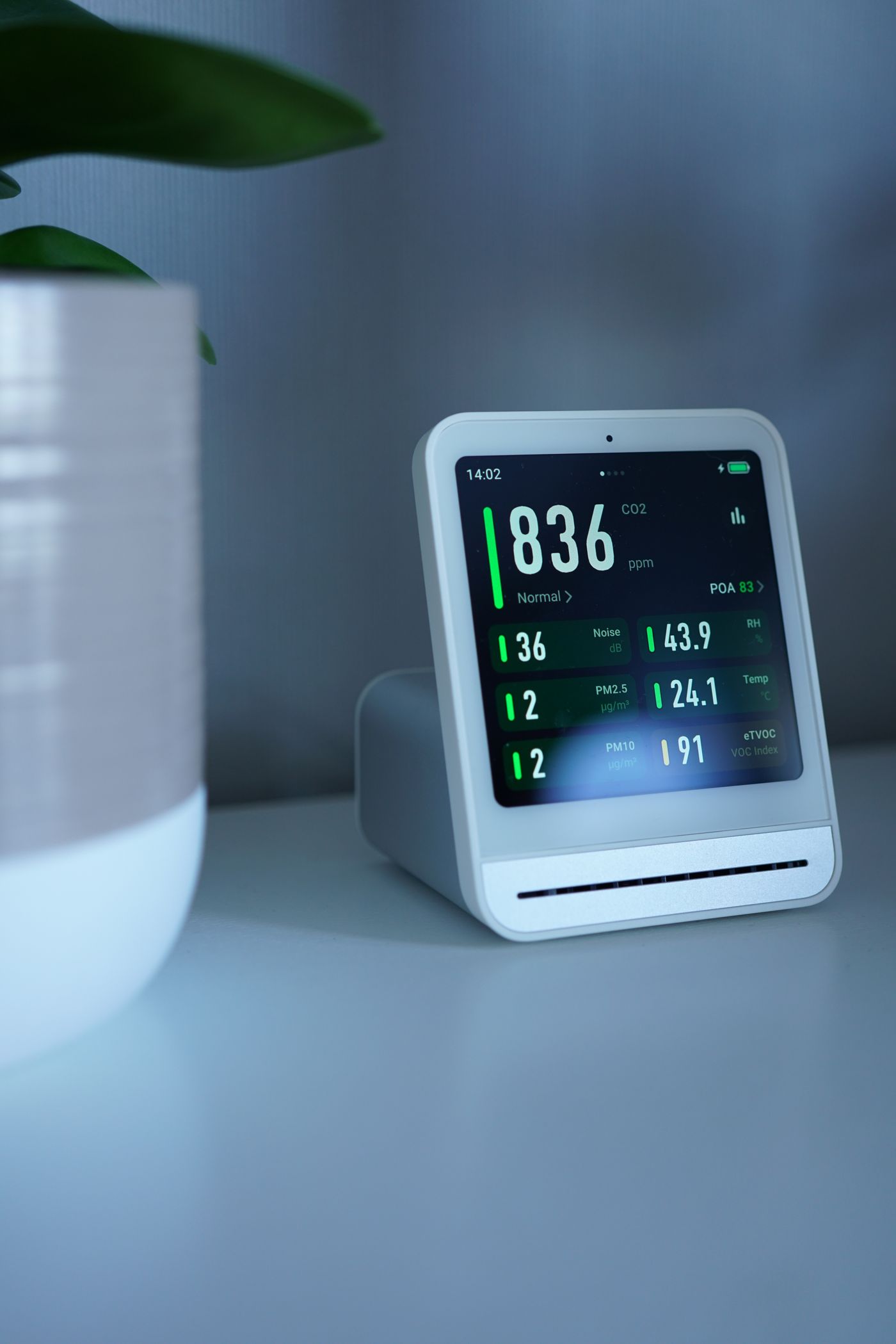
A room air sensor can make everyday changes visible. A reading may rise while cooking, fall after ventilation or change as more people occupy a room. That does not establish that the room has been comprehensively assessed or is harmless to health.
Start by identifying what the device actually measures. Temperature, relative humidity, carbon dioxide, particles and volatile organic compounds are different quantities. A product containing one sensor does not automatically cover the others. The EPA explicitly notes that the features and capabilities of low-cost indoor monitors vary.
Separate the measurement from the display
Read the technical description rather than relying only on the coloured summary. Is the quantity directly measured with an appropriate sensor, or estimated from other signals? A value described as equivalent or estimated should not quietly be treated as a direct measurement. Check its units, range and stated accuracy as well.
A green, amber or red display often uses thresholds chosen by the manufacturer. It is not a universal judgement covering every possible pollutant. Two devices may show different colours for similar underlying readings. Compare the actual quantity first, not just the colour.
Carbon dioxide is not carbon monoxide. An ordinary room monitor does not replace a suitable dedicated carbon-monoxide or smoke alarm. A reassuring particle reading does not rule out another hazard either. During a safety alarm or an acute suspected problem, follow the appropriate safety response rather than relying on a comforting number from a different device.
Choose a location for the question
To observe usual conditions around a desk, use a representative position in the room. Breathing directly onto the sensor, placing it beside an open window gap, a radiator or a purifier outlet can strongly affect the local reading. Follow the required clearances and allow stabilisation after relocation.
One measurement point does not necessarily describe every corner. A sensor beside a cooker may record a local peak unlike conditions elsewhere. A distant position may barely register a brief local event. Decide whether you are investigating a source or observing broader changes in an occupied area.
Keep the position consistent for comparisons. Moving daily between a windowsill, shelf and doorway makes differences difficult to interpret. Note simple events alongside readings, such as cooking, ventilation or extra occupants. That turns a sequence of numbers into an understandable observation.
An example without premature diagnosis
Suppose particle readings rise while frying. Check whether the pattern recurs during a similar activity and whether appropriate ventilation changes the trend. This supports a connection, but does not identify the exact composition of every particle. The monitor is not a laboratory analysis.
If two devices disagree side by side, allow both to stabilise according to their instructions. Compare units and averaging periods. One may display an immediate value while the other smooths readings over time. Ageing, contamination and different sensing methods may contribute too. Recalibrating against whichever device shows the nicer result is not a dependable answer.
Check maintenance and permitted calibration procedures. Some products require defined conditions; pressing a calibration button in an unsuitable environment can make readings less useful. Do not introduce liquid into sensitive openings or dismantle them unless explicitly instructed.
Draw a limited, useful conclusion
A sensor is useful when it supports a concrete question: how does humidity change after showering, what happens during a normal ventilation routine, or do unusual readings persist after changing an activity? These are narrower and more testable questions than claiming that a device measures healthy air.
Persistent problems, visible damp, unusual smells or symptoms may call for a professional investigation of the underlying cause. A monitor can contribute observations but cannot make a medical diagnosis. Keep that boundary in mind even when an app calculates an impressively precise-looking overall score.