Planning a video doorbell charging routine
Base charging on your own usage and account for the temporary interruption while the battery is away.
A video doorbell's battery life is not governed by the calendar alone. Event frequency, live viewing, settings and environmental conditions all affect consumption. An advertised number of months is therefore not a substitute for observing the device at your entrance.
Record the date after the first full charge and follow the displayed trend. A percentage is not a precise promise of remaining days. Watch for changes after adjusting detection zones or during substantially different outdoor temperatures.
Plan charging as maintenance
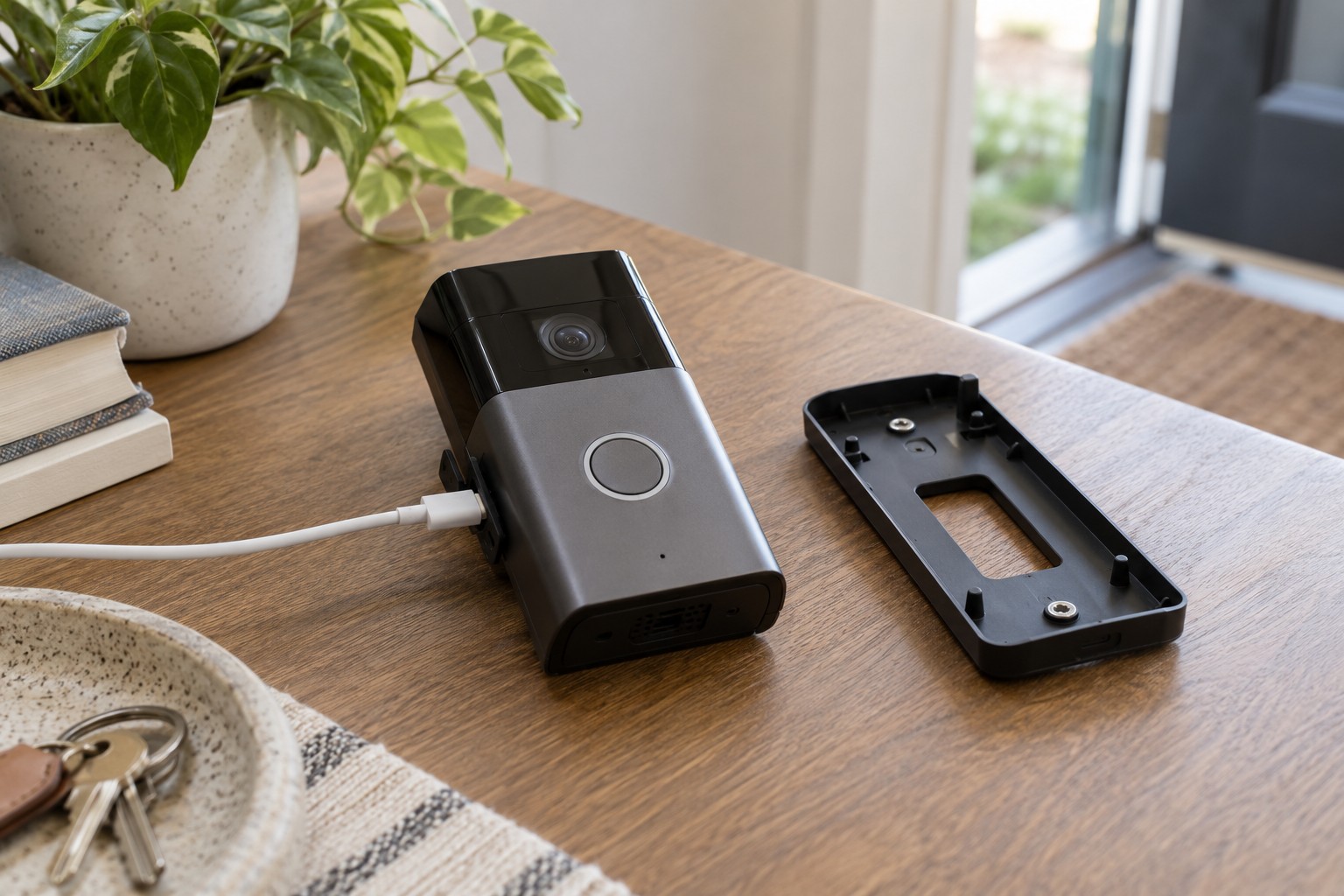
Read whether the battery is removable or the whole unit must be charged. Keep the proper release tool and charging cable together. Access should not require unsafe climbing. Choose a time when temporary loss of video operation is acceptable.
Use the approved supply and follow charging-temperature limits. Do not warm a cold battery with a heater. Do not continue charging a damaged, swollen or unusually smelling battery; follow the manufacturer's safe-handling guidance and obtain support.
On some models, an attached power source assists the battery rather than eliminating its role. Do not assume it keeps the battery full under every condition. Check the exact model and installed connection.
Reduce unnecessary activity carefully
If many irrelevant events occur, investigate their cause. Restricting detection to the required area may be better than disabling every alert. Test that visitors are still detected in time after a change. Lower activity is useful only if the intended function remains.
Review how long live view stays open. Continuous viewing is different from occasionally answering a ring. Compare short periods with known settings instead of changing several functions together.
After refitting, check secure attachment, connectivity, an actual ring and the charge indication. A charged battery does not establish that the unit is correctly mounted or notifications have resumed. Record the date and adjust the next reminder using the observed pattern.
Before a longer absence, agree who will notice a low charge and can act if necessary. A spare battery helps only if it is intended for the model, charged and accessible. Do not assume that someone receiving camera alerts has also agreed to manage charging or can reach the property.