Positioning a subwoofer in a living room
A subwoofer needs a suitable room position and system connection. A corner is not a universal answer.
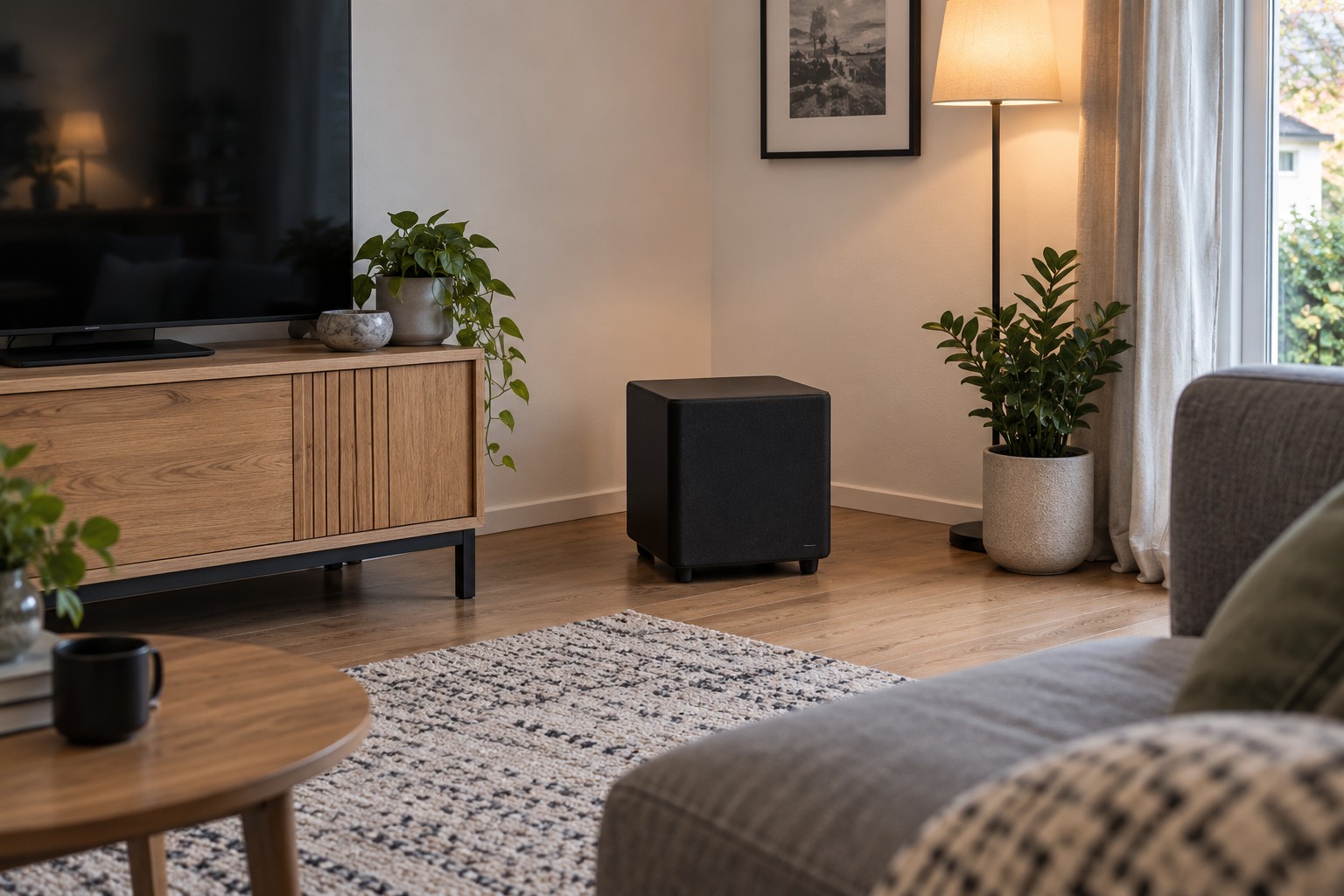
A subwoofer handles lower frequencies than the other speakers, but that does not mean it can disappear anywhere. Room boundaries and seating affect the result, while cabinet openings, wiring and secure placement impose practical limits.
Check compatibility first. A model paired wirelessly with a particular soundbar is not automatically a general Bluetooth speaker. Some belong to a specific ecosystem; others have separate signal inputs. Establish the correct connection before comparing locations.
Compare two suitable positions
Choose two places permitted by the instructions and safe in everyday use. Preserve required openings and clearances. Do not lift a heavy unit insecurely or put it on unsuitable furniture. Use the intended handling method and assistance where needed.
Play a familiar recording with reasonably consistent bass at moderate volume. Listen from the usual seat without changing other settings between positions. Notice whether some notes dominate while others become difficult to hear. A louder overall impression is not automatically a more balanced one.
Include other important seats. A result that works centrally may differ at the side. Compare the positions people actually use, not just a convenient point beside the appliance.
Check furniture and flooring
For rattles, look for loose objects, doors or glasses nearby. The subwoofer may reveal an existing resonance without being faulty itself. Remove the suspected item temporarily. Avoid putting objects on the cabinet where prohibited; vibration can move them.
Suitable feet or approved pads need to fit the product and remain stable. A soft improvised layer is not automatically effective isolation and can worsen support. Consider delicate flooring and permitted operating orientation.
Test wireless reliability at the actual position. Metal or an unsuitable cabinet can affect the connection. Include startup after a normal break, not only an already-running session.
Fine-tune afterwards
Run any available automatic room adjustment once the position is final. Change level, crossover or phase only as described by the system and one setting at a time. Not every product offers those controls or uses the same values. Record the starting arrangement before experimenting.
The aim is to complement the other speakers, not maximise bass in every scene. Check speech, music and ordinary television material. If the subwoofer continually draws attention or unnecessarily disturbs adjoining rooms, reconsider both its position and level.